Drug Coverage Scorecard
The state Medicaid slides you'd otherwise build by hand before a P&T review, a QBR or a payer meeting, already built and cited. Pick one drug or one drug class. You get its status in the 21 states we verify, with the PA and step therapy flags as each state prints them. (The other 2 we track show "see source" and a link.) It also has what changed between the versions we've archived and its 2027 Express Scripts and Optum Rx exclusions by exact form. Every row cites its page.
PDF for reading, PowerPoint for the deck, Excel for the appendix.
What the slides look like
Four of the seven slides in the sample deck. Download the whole sample to check it in PowerPoint, Acrobat or Excel:
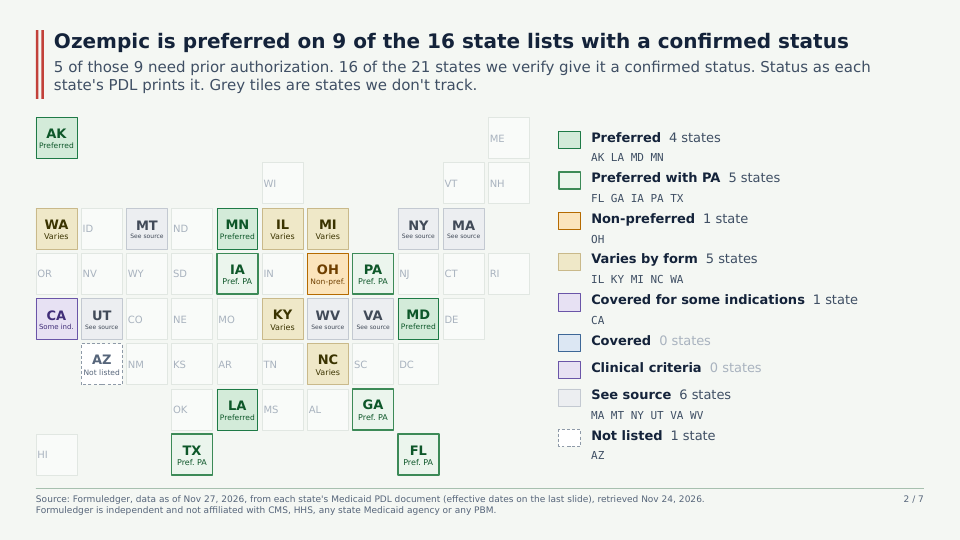 Status by state
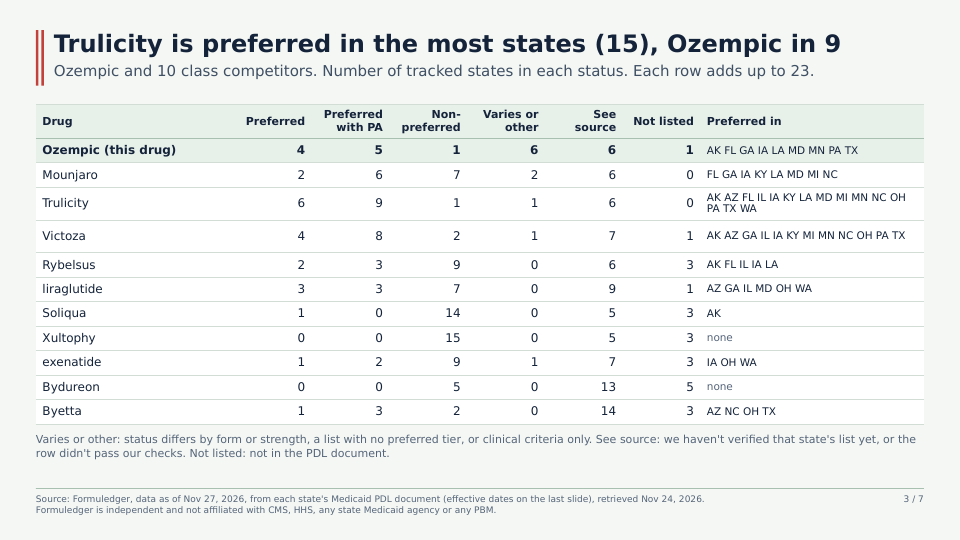 Class competitors
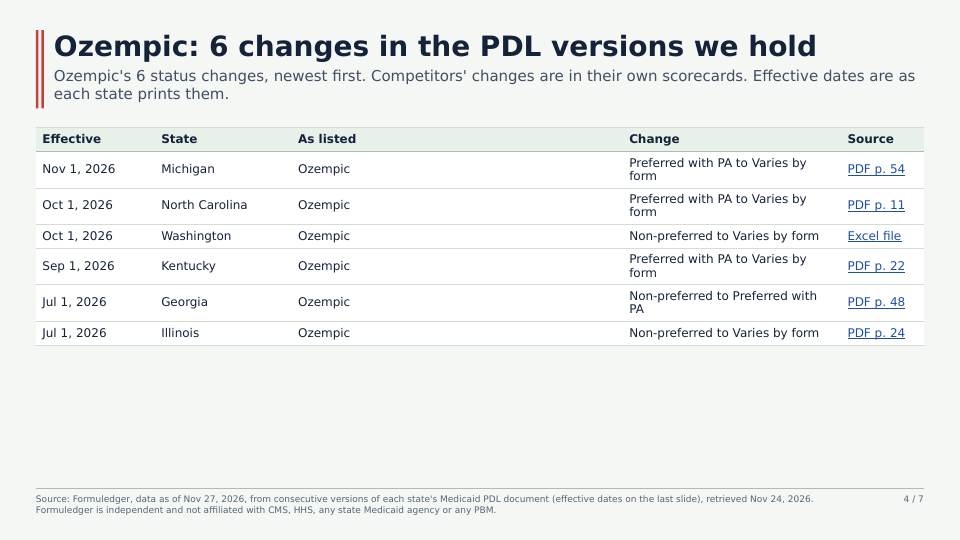 Changes, newest first
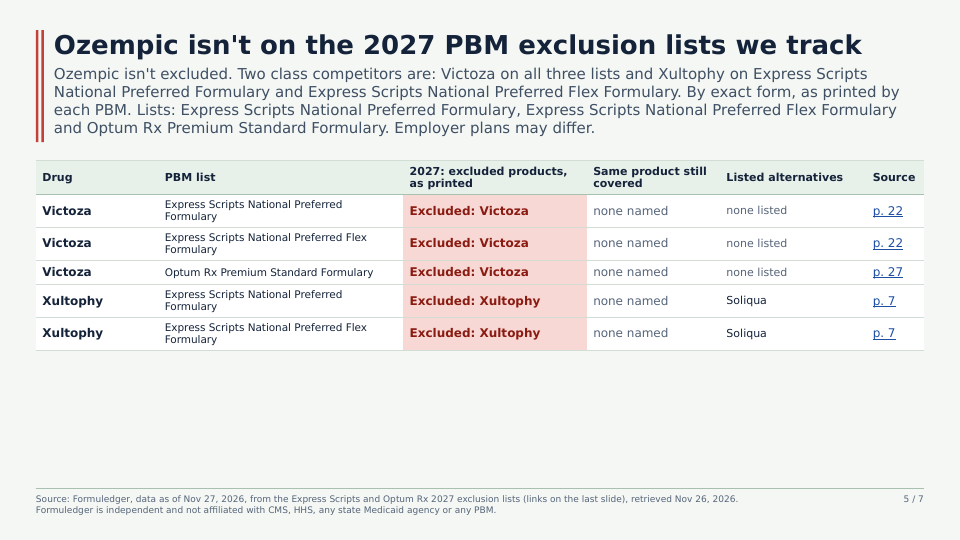 2027 PBM exclusions
What you get
Drug Coverage Scorecard
$149 per drug or drug class
- Covers one drug or one drug class, chosen when you redeem the key
- Status in the 21 states we verify (preferred, preferred with PA, non-preferred, varies by form, covered, clinical criteria), each linked to the page of the state's document with its effective date and file hash. The other 2 we track show "see source" with a link
- Change history from every PDL version we've archived
- The drug's rows of the PBM x Medicaid crosswalk: 2027 Express Scripts and Optum Rx exclusions by exact form, the alternative the PBM names, and the forms it keeps covered (CVS Caremark once published)
- Class competitors side by side, with counts of states where each is preferred
- PA, step therapy and quantity limit flags and short notes as the state prints them. We don't reproduce full criteria text. The row links to the page that has it.
- A PowerPoint deck: the state grid, class competitors, recent changes and 2027 PBM exclusions, every slide with its sources
- PDF, PowerPoint, Excel and a printable page, with updated downloads for 12 months
- Posted P&T or DUR review dates for the class
How it works
- Pay by card through Dodo Payments. You get a license key by email and on the page you land on after paying.
- That page opens with your key filled in. Pick one drug or one drug class, check it and confirm.
- Download the PowerPoint, PDF and Excel. The key stays tied to that drug or class, so come back any time in the next 12 months for fresh copies when states post new lists.
Already have a key? Redeem it here. Help with your key or a refund: support@formuledger.com.
Scorecard or Data License
Buy a scorecard if you want it finished: the slides, the document and the appendix for one brand or one class, with sources already on every slide.
Buy the Data License if you want all of it as data: every drug in every state we track, every archived version, the change log, the 2027 PBM crosswalk and the P&T calendar, as CSV and Excel for your own models. It costs about the same as two scorecards and covers far more. But there are no slides, so you build the tables yourself.
For P&T and DUR class reviews
If you prepare a class review for a state P&T committee or DUR board, or the response to one, buy the class scorecard rather than a drug. It puts every drug in the class on one grid across the 21 states we verify, so you can see where peer states put each product.
- The peer-state grid: each drug's status in every state we track, with PA and step therapy notes as the state prints them.
- The change history: every status change, new listing and removal between the versions we hold, with both effective dates.
- Upcoming meetings: the P&T and DUR dates other states have posted for this class, with the agenda link.
- Citations: every row names the state's document, its effective date and the page, so a table can go into a committee packet with its sources attached.
Pick it on the class list first, and check which drugs the class holds. A key binds to the class you choose.
What $149 is up against
Doing it by hand means opening every state's file, finding every form of the drug, copying status and flags state by state and then building the slides. Then doing it all again when the next list posts. The enterprise formulary tools cover far more than we do, but you buy them after a demo, on an annual contract. A scorecard is a card payment and a download. Prices compared.
Quotes, invoices and W-9s
Dodo Payments is the seller of record. It emails the receipt and the invoice, with any sales tax shown. Need a quote before anyone pays? Email contact@formuledger.com. How procurement works.
Questions
What counts as one scorecard?
One scorecard covers one drug or one drug class: one drug as it appears in our drug index (all strengths and forms of that brand or generic), or one class from the class list. A class scorecard gives every drug in the class a summary row. The PDF has the state by state table for up to 25 of them, and the Excel file has every listing for all of them.
Check the class list before you pick. Obesity brands such as Zepbound and Wegovy are in Anti-obesity, not in GLP-1 agonists.
Can I switch the drug later?
No. A key binds to the first drug or drug class you pick, so double check before you confirm. If you picked the wrong one by mistake, email support@formuledger.com the same day and we'll sort it out.
Can I use the slides in a client deck?
Yes, within limits. The terms let consultants and agencies use it to advise clients and put summary tables, or up to 50 rows per deliverable, in a client deliverable with the credit "Source: Formuledger, data as of [date]". A 23-state by 8-product status grid on a slide in a client deck, for example, is a summary table, so it's fine with that credit. The slides already carry their sources. You can't hand the client the scorecard files themselves in place of their own copy.
How current is it, and how far back does the history go?
We check state sites weekly, and daily around the January and July switch dates. 21 of 23 states currently pass our checks and show statuses. The other 2 say "see source" with a link instead of guessing. History depth varies by state: 15 of the 23 go back before 2026, while Michigan and Ohio start in October 2026. Each state page lists the versions we hold.
How do you check accuracy?
Every state's parse has to pass row count, class and spot checks against PDFs we read ourselves before it shows statuses. In a November 27, 2026 check against the state documents, 1,931 of the listings we sampled print a status. Of those, 1,560 matched the status we show and 371 showed "see source" because we hold that status back. None showed a wrong status. Some detail (a note, a form or strength, a missing row) still differed on 186 of the 1,943 listings, and we're fixing those in our readers. In our QA round of November 26, 2026, 15 of 15 sampled January changes matched the source documents, and 10,054 automated checks on the PBM rows passed with 0 failures. It isn't error free, which is why a row we can't confirm says "see source". Methodology.
What if a row is wrong?
Email contact@formuledger.com with the state, the drug and the page link. We check it against the source, fix the row or the parser and send you a corrected file. Most corrections go out within two business days. If we can't fix it, we refund you, up to 30 days from purchase. And within 14 days you can ask support@formuledger.com for a full refund for any reason (one per customer per product). Refund policy.
Who's behind it?
Formuledger is an independent publication. It takes no money from any state, PBM, plan or manufacturer, and there's no sales team. What you can check instead is on the page: every row's source page, the public methodology and QA results, the sources list with file hashes, and the corrections policy above. Questions: contact@formuledger.com. Orders: support@formuledger.com.
Can I expense it, or get an invoice?
Pay with a company card. Checkout, invoices and sales tax are handled by Dodo Payments, our merchant of record, so the charge on your card shows their name. Dodo emails the receipt and invoice. Quotes, invoices and W-9s are covered on the pricing page.
Is this coverage advice?
No. It's a summary of public documents. Plans and states apply their own rules, so check the linked page before you act on any row. See the disclaimer and methodology.